Why AI struggles with new drug targets – and how physics could help
Read Full Article on Drug Target Review
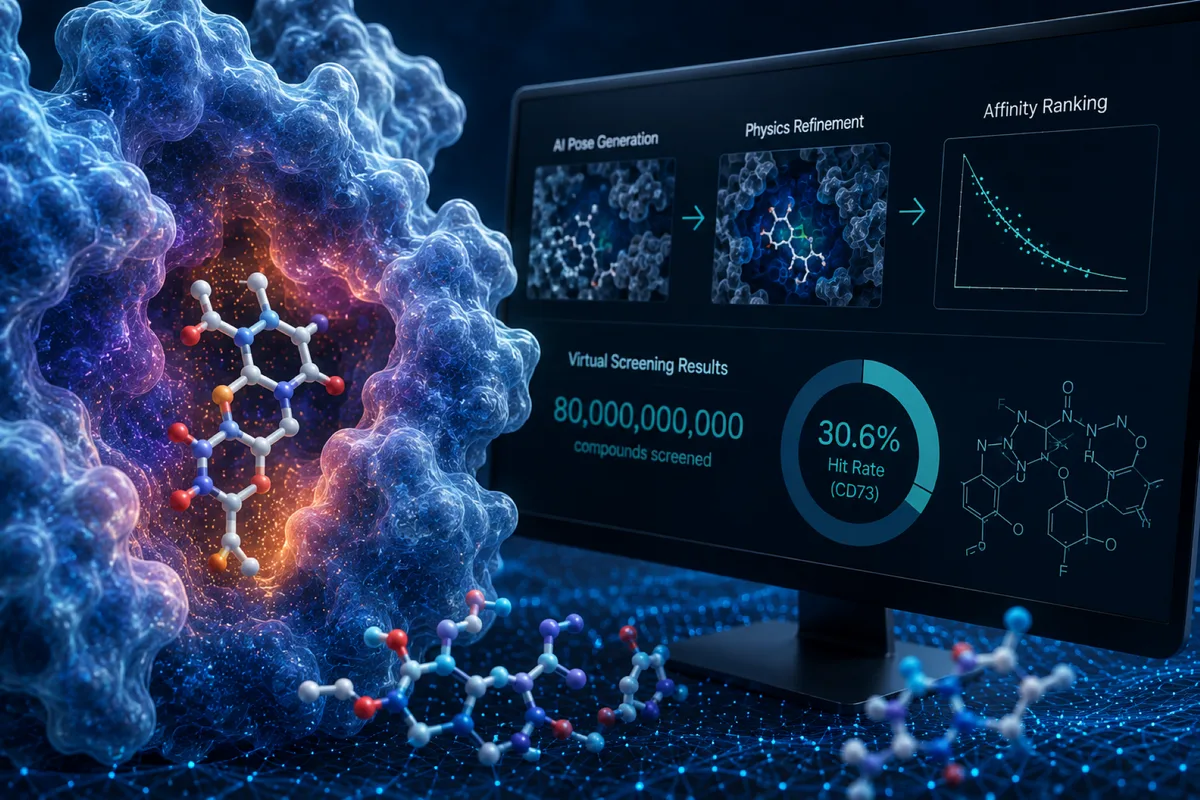
In Drug Target Review, Deep Origin co-founder and CSO Garegin Papoian explains why AI docking models falter on novel targets and how DODock's physics-based refinement held up, reaching 80% pose accuracy on OpenBind and a 30.6% hit rate against CD73.
In Drug Target Review, Deep Origin co-founder and CSO Garegin Papoian explains why AI models for virtual screening often underperform on proteins and ligands unlike their training data, a failure he calls the “memorisation trap.” “The existing models seem to operate in large part by memorising the training material,” he writes, and data leakage in common benchmarks, where near-identical proteins and similar chemical scaffolds appear in training sets, hides the problem until the models meet genuinely novel targets.
The article describes DODock, which pairs AI-generated binding poses with refinement by DOFast, a lightweight physics engine that calculates molecular forces, to avoid the physically impossible structures pure AI methods can produce for unfamiliar complexes. On OpenBind, DODock reached 80% pose accuracy versus 4–28% for co-folding models; on Runs N’ Poses it kept above 50% accuracy on the least-similar complexes while competitors fell to 25% or below. In prospective lab validation, it delivered a 30.6% hit rate against CD73 (56 of 183 compounds with IC50 below 500 µM) and a 3.1% hit rate against the protein-protein interaction target IL-17A. “For virtual screening to become the front-line engine in early drug discovery, computational tools must prove they are consistently predictive,” Papoian concludes.
For our own write-up of the work, see DODock and DOScore: Closing the Generalization Gap in Structure-Based Virtual Screening and the preprint in our resource library.