Deep Origin Unveils Breakthrough in Virtual Screening with DODock
Read Full Article on SynBioBeta
SynBioBeta covers DODock, Deep Origin's framework combining AI pose generation with physics-based refinement, which holds above 50% pose accuracy on unfamiliar protein-ligand complexes where leading co-folding models fall below 25%.
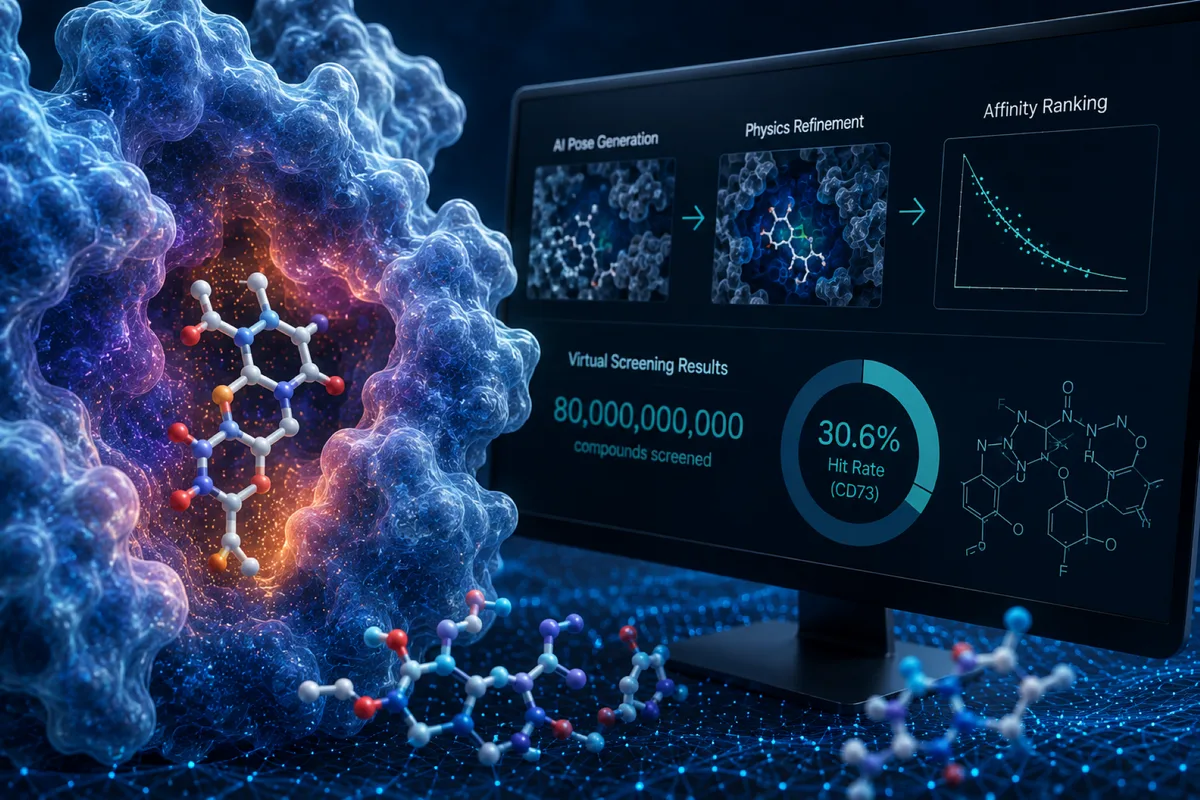
SynBioBeta reports on DODock, Deep Origin’s virtual screening framework, and the generalization problem it targets. Existing structure prediction models lose accuracy sharply when applied to biological targets unlike anything in their training data: leading co-folding systems drop from the 80s to below 25% pose accuracy on unfamiliar complexes. DODock holds above 50% under the same conditions. To keep those numbers honest, Deep Origin filtered its evaluation sets aggressively, removing proteins above 30% sequence similarity and ligands above 0.4 Tanimoto similarity to the training data, and reported 80% accuracy on OpenBind against 4–28% for competing methods.
The article describes the architecture as three parts working together: a diffusion model that proposes 3D poses, the DOFast physics engine that computes molecular forces, and an AI ranker that scores atomic contacts. In prospective screening, the approach produced a roughly 30.6% hit rate against CD73 — an immuno-oncology target — compared with about 0.3% from earlier machine learning screens. Deep Origin published the full methodology openly, inviting replication and independent validation by other groups.
For our own write-up of the work, see DODock and DOScore: Closing the Generalization Gap in Structure-Based Virtual Screening and the preprint in our resource library.