AI virtual screening tool boosts hit rate 100-fold on challenging drug targets
Read Full Article on Discover Pharma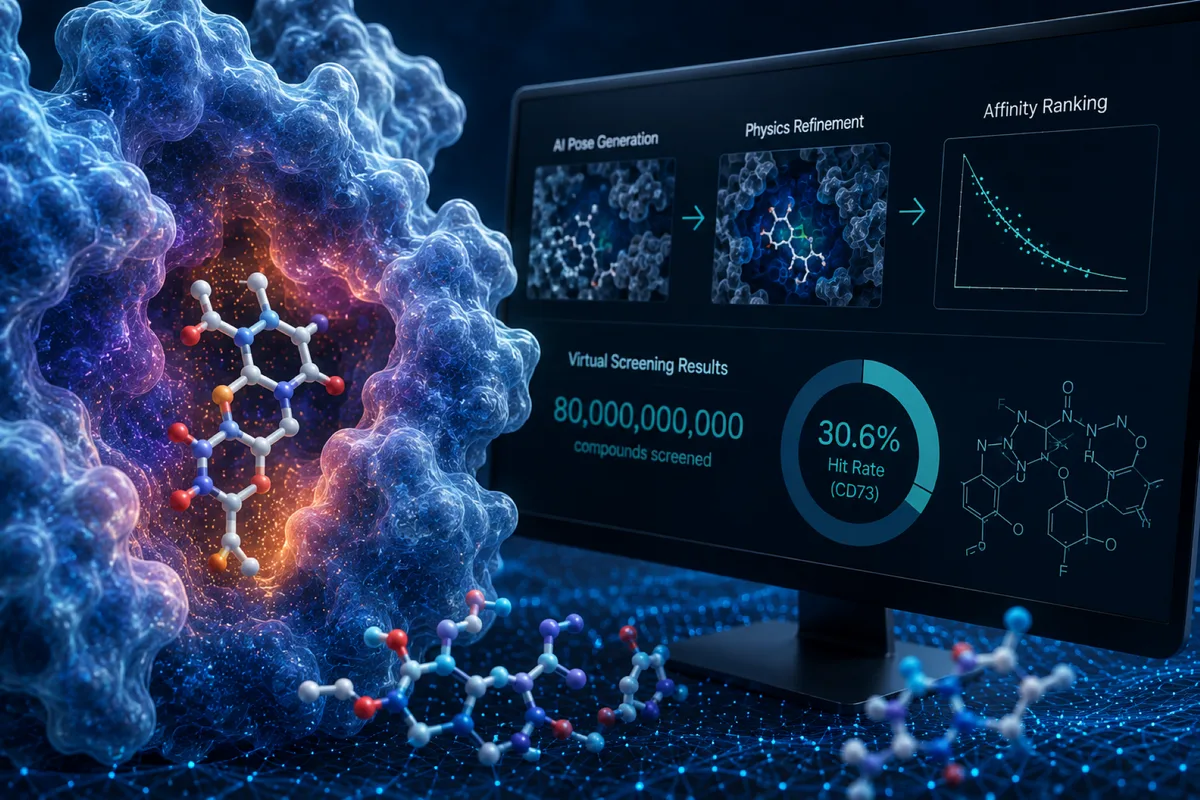
Discover Pharma reports on Deep Origin's DODock and DOScore, which screened an 80-billion compound library and hit roughly 30% actives against CD73 — about a 100-fold improvement over prior machine learning screens.
Writing for Discover Pharma, Liza Laws covers Deep Origin’s DODock and DOScore and the problem they address: computational screens often look accurate only because similar molecules or protein structures already appeared in their training data, and that accuracy collapses on genuinely novel targets. Deep Origin’s approach pairs a diffusion-based model that generates binding poses with a physics engine for molecular calculations, then ranks candidates with DOScore, holding up across multiple independent benchmark datasets.
In prospective validation, the system screened an 80-billion compound library and produced its strongest result against CD73, an immuno-oncology target, where roughly 30% of tested molecules proved active — about a 100-fold improvement over prior machine learning screens. The article notes results across IRAK4, Factor XIa, and IL-17A as well, and that the compounds identified showed real chemical novelty rather than minor variations on known drugs.
For our own write-up of the work, see DODock and DOScore: Closing the Generalization Gap in Structure-Based Virtual Screening and the preprint in our resource library.